Install Findmino as an app for the best experience!
Accountant
(Financial Accountant, Management Accountant, Certified Public Accountant, Accounting Technician)
Business & Finance
Salary
€30,000 - €90,000/yr
Level
Senior
Outlook
Stable
Sector
Business & Finance
What does an Accountant do?
As an accountant you prepare, examine, and analyse financial records to ensure accuracy and compliance with Irish tax laws and regulations. Your daily work involves preparing financial statements, managing budgets, reconciling accounts, and advising clients or employers on financial decisions. You may work across areas such as audit, taxation, management accounting, or insolvency, depending on your specialism. You collaborate closely with business owners, finance teams, Revenue, and sometimes legal professionals to ensure that financial affairs are handled correctly and transparently.
A Day in the Life
Listen: a day as an Accountant
You arrive at your firm's office in Cork city centre at eight-thirty, grab a coffee, and open your emails. There are queries from two small business clients about their VAT returns, which are due to Revenue by the end of the month, and a reminder from your manager about a set of annual accounts that need to be finalised before Friday. You open Surf Accounts and Sage, the two accounting software packages your firm uses most, and start pulling together the figures for a limited company client in the retail sector. By ten o'clock you are deep into a bank reconciliation, which means checking that every transaction on the client's bank statement matches what is recorded in their accounting system. It sounds straightforward but it rarely is. You find two payments that have not been coded correctly and one direct debit that the client forgot to mention. You note these and send a short query to the client before moving on.
Videos about Accountant
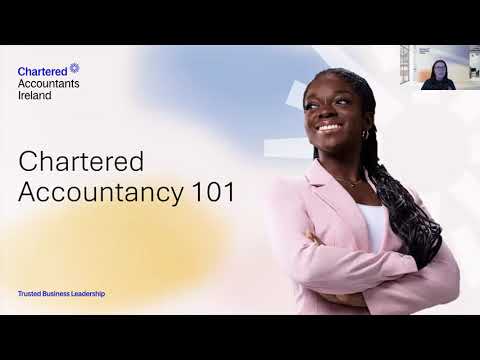
Chartered Accountancy 101 - Studying the ACA qualification in Ireland.
Chartered Accountants Ireland
Required Education
Leaving Certificate subjects such as Accounting, Mathematics, Business, and Economics provide a strong foundation for this career. The most common route into professional accountancy is a Level 8 Honours Bachelor degree in Accounting, Commerce, or Business from a university or technological university, followed by professional examinations such as the ACA (Chartered Accountants Ireland), ACCA, or CPA Ireland qualifications. An alternative entry route is the Accounting Technician apprenticeship (Level 6, NFQ), offered through Accounting Technicians Ireland (ATI) in partnership with SOLAS, which allows you to earn while you learn. PLC courses in Accounting or Business at Level 5 or 6 can also provide a pathway into technician roles or progression to degree programmes via the CAO. Full membership of a recognised professional body such as Chartered Accountants Ireland, ACCA, or CPA Ireland is expected for senior accountancy roles.
Required Skills
Career Perspective
Many accountants begin their careers in practice, often with a small or mid-size firm or one of the Big Four firms in Dublin, completing their professional exams while gaining practical experience. After qualifying, you may choose to remain in practice, specialise in areas such as audit, tax, or forensic accounting, or move into industry as a management or financial accountant within a company. With several years of experience, progression to roles such as Finance Manager, Financial Controller, or Chief Financial Officer (CFO) becomes achievable. Some qualified accountants also move into consultancy, public sector finance, or establish their own practice.
AI Impact on the job
AI and automation tools are increasingly handling routine bookkeeping, data entry, and transaction categorisation tasks that were once time-consuming parts of an accountant's role. This is shifting the focus of accountancy work towards higher-value activities such as financial analysis, strategic advice, and ethical judgement, which AI cannot easily replicate. Cloud-based accounting platforms with built-in AI features, such as automated reconciliation and anomaly detection, are now standard in many Irish practices and businesses. Accountants who embrace these tools and develop strong advisory and analytical skills will be best placed to thrive as the profession evolves.
Career Ladder
→ Accountant (Current role)
Related Studies
Commerce / Business Studies
4 year • Business & Economics
BachelorAccounting
4 year • Business & Economics
FETBusiness Studies (QQI Level 5)
1 year • Business & Economics
ApprenticeshipAccounting Technician Apprenticeship
2 year • Business & Economics
PostgraduateChartered Accountancy (ACA)
2 year • Business & Economics
Employers in Ireland
Organisations in Ireland that employ people in this occupation.
Dublin, Cork, Limerick
Audit, tax, advisory and financial reporting for major clients
Dublin, Cork, Galway, Limerick, Waterford
Audit, taxation, assurance and business advisory services nationwide
Dublin, Cork, Galway
Financial audit, tax compliance and management accounting services
Dublin, Cork, Limerick, Waterford
Assurance, tax, transactions and financial consulting for clients
Nationwide
Tax compliance, audit and financial enforcement for the Irish state
Nationwide
Management accounting and financial planning across health services
Dublin, Nationwide
Financial reporting, regulatory accounting and internal audit functions
Dublin
Group financial reporting and management accounting for global operations
Dublin, Cork, Galway, Limerick
Audit, tax and insolvency accounting for SMEs and corporates
Dublin, Cork, Galway
Statutory audit, tax compliance and financial advisory for businesses
Dublin, Cork
Accounting, audit and tax services for owner-managed and listed firms
We don't know whether these employers currently have vacancies — always check their own website. And if there's somewhere you'd really love to work, it can be worth applying anyway, even without an open vacancy.
Our tools can help you with that:
Famous Irish people who did this
Get inspired by people whose path led them to work like a Accountant. Tap a face to read their story.


This website uses cookies
We use functional cookies and — with your consent — cookies for preferences, statistics and marketing.