Install Findmino as an app for the best experience!
Radiation Therapy
Health & Social Care
Duration
4 years
Level
Bachelor
Outlook
Growing
What will you learn?
Radiation Therapy is a four-year Honours Bachelor degree that prepares you to plan and deliver radiotherapy treatments for patients with cancer and other conditions. You study anatomy, physiology, oncology, radiation physics, and radiobiology, developing a deep understanding of how ionising radiation interacts with human tissue. A significant portion of your training takes place on clinical placement in national cancer centres across Ireland, where you work alongside experienced radiation therapists using state-of-the-art linear accelerators and treatment planning systems. You also gain experience in imaging technologies, patient care, and quality assurance procedures. A typical week combines lectures and laboratory sessions on campus with scheduled clinical placement hours, where you progressively take on greater responsibility for patient-facing treatment delivery.
Videos about Radiation Therapy
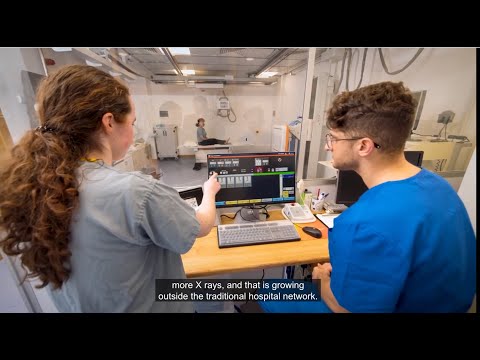
UCD Radiography
Required Education
Entry to the BSc (Hons) in Radiation Therapy at Trinity College Dublin is through the CAO, and points requirements are consistently high, reflecting strong competition for a limited number of places. You will typically need to meet a minimum Leaving Certificate requirement of six subjects, including Mathematics and a laboratory science subject such as Biology, Chemistry, or Physics, ideally at Higher level. Higher-level Biology and Chemistry are particularly advantageous given the biological and physical sciences content of the programme. Applicants may also enter through a relevant QQI Level 5 or Level 6 FET award in Science or Health Sciences, subject to the college's specific QQI entry requirements. Mature applicants aged 23 or over may apply directly through the CAO mature entry route, and the HEAR and DARE access schemes are available for eligible applicants from socioeconomically disadvantaged backgrounds or with disabilities.
Core Subjects
Career Prospects
Demand for radiation therapists in Ireland remains strong due to continued investment in cancer services and an ageing population with rising cancer incidence. The HSE and private providers such as the Bon Secours Group regularly recruit graduates, and waiting lists for cancer treatment mean staffing is a national priority. Graduate employment rates for this programme are consistently high, with most graduates securing posts within months of qualifying. Salary scales for staff-grade radiation therapists in the public sector follow HSE pay agreements, typically starting in the region of €36,000–€42,000 gross per annum, rising significantly with seniority.
Impact of AI on this program
Artificial intelligence is increasingly integrated into radiation therapy, particularly in automated treatment planning, image segmentation, and adaptive radiotherapy workflows. You will need to understand and critically evaluate AI-assisted planning tools, as these are already in use in Irish cancer centres and are becoming standard practice internationally. However, clinical judgement, patient communication, and hands-on treatment delivery remain firmly human responsibilities, meaning AI is expected to augment rather than replace the radiation therapist's role. Engaging with these technologies during your training will be an advantage in a rapidly evolving clinical environment.
CAO courses & points
1 CAO course lead to this qualification. Points shown are last year's Round 1 score.
Where can you study this?Providers and indicative points are curated with AI support. Always double-check with the institution itself.
Verified yesterday
Providers and indicative points are curated with AI support. Always double-check with the institution itself.
CAO points (indicative): 460-550 (2024)
* Indicative only: CAO points change every year. Always check the current points on cao.ie and with the institution.
How to apply
Applications for BSc (Hons) Radiation Therapy programmes in Ireland are made through the CAO (www.cao.ie) for undergraduate entry; candidates must meet specific subject requirements (typically including Biology and Chemistry or Physics) and may be required to attend a selection interview or satisfy health/Garda vetting requirements prior to acceptance.
Possible Job Matches
Right after this study
Jobs you qualify for immediatelySimilar Studies
Addiction Studies
This degree prepares you to work directly with individuals and communities affected by substance misuse, behavioural addictions, and related mental...
4 years
BachelorAdvanced Therapeutic Technologies
This degree focuses on the science and clinical application of advanced therapeutic technologies, including cell therapy, gene therapy, and...
4 years
BachelorApplied Social Care
Applied Social Care at honours degree level prepares you to work directly with vulnerable individuals and communities across a wide range of...
4 years
Discover more on Findmino
Other studies, careers, ideas and blogs you might not know yet.
This website uses cookies
We use functional cookies and — with your consent — cookies for preferences, statistics and marketing.