Install Findmino as an app for the best experience!
Chef
(Cook, Culinary Operative, Kitchen Chef, Chef de Partie)
Hospitality & Tourism
Salary
€28,000 - €65,000/yr
Level
Operational
Outlook
Stable
Sector
Hospitality & Tourism
What does a Chef do?
As a Chef you plan, prepare and cook food to a high standard in professional kitchens, ranging from restaurants and hotels to hospitals, schools and corporate canteens. Your day involves mise en place — chopping, marinating, portioning and organising ingredients — before service begins, then working at speed and under pressure to deliver dishes consistently. You collaborate closely with other kitchen staff, from commis chefs and kitchen porters to head chefs and front-of-house teams, ensuring every plate meets quality and presentation standards. You are also responsible for food hygiene and safety compliance, monitoring stock, minimising waste and following allergen management procedures throughout each shift.
A Day in the Life
Listen: a day as a Chef
Your alarm goes off at 6:45 a.m. You are working the opening shift at a busy hotel restaurant in Galway city. You arrive by 7:30 a.m., change into your chef whites and steel-toed clogs, sign in and check the day's function sheet pinned to the board in the kitchen office. There are sixty covers booked for lunch and a private dinner for thirty this evening, so the head chef has already written a prep list on the whiteboard. From 8:00 a.m. you begin mise en place — French for 'everything in its place'. This means peeling and dicing vegetables, portioning chicken breasts, reducing stocks, and preparing sauces that need time on the stove before service. You check the walk-in fridge for stock levels and note anything running low on the ordering clipboard. Date labels on every container are your responsibility, and anything past its use-by date is removed immediately and logged.
Videos about Chef
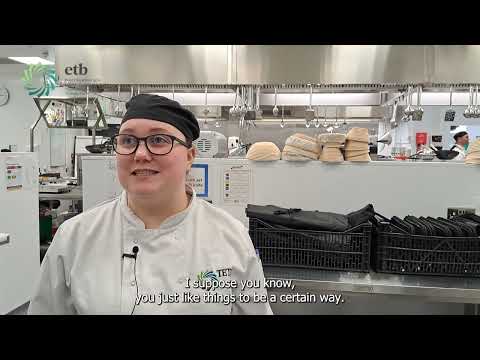
Tipperary ETB Commis Chef Apprentices win big at national exhibition
Tipperary ETB
Required Education
While there is no single mandatory Leaving Certificate subject, Home Economics, Biology and Mathematics are all useful foundations. The most direct route into the profession is through a SOLAS-approved apprenticeship: the Commis Chef apprenticeship (NFQ Level 6) and the Chef de Partie apprenticeship (NFQ Level 7) allow you to earn while you learn, combining on-the-job training with off-the-job education at a designated provider. Alternatively, a QQI Level 5 or Level 6 PLC in Professional Cookery or Culinary Arts at a College of Further Education provides a strong practical grounding and can serve as a pathway into higher education. Full degree programmes in Culinary Arts are offered at NFQ Level 7 and Level 8 by institutions such as TU Dublin, ATU and MTU for those wishing to combine advanced culinary skills with business and management knowledge. Fáilte Ireland also offers continuing professional development programmes relevant to chefs working in the tourism and hospitality sector. There is no statutory registration body for chefs in Ireland, but employers commonly expect evidence of HACCP training and a recognised food safety qualification.
Required Skills
Career Perspective
Most chefs begin as a Commis Chef or Kitchen Assistant, learning the fundamentals of kitchen work under the supervision of more senior colleagues. With experience and further training — including completion of a Chef de Partie apprenticeship or a culinary degree — you can progress to Chef de Partie, where you take responsibility for a specific section of the kitchen. From there, the typical progression leads to Sous Chef and ultimately Head Chef or Executive Chef, where you manage the entire kitchen operation, develop menus and oversee a team. Some experienced chefs go on to open their own restaurants, move into food styling, culinary education or food product development.
AI Impact on the job
AI-powered tools are beginning to assist chefs with menu engineering, nutritional analysis and inventory forecasting, reducing administrative tasks and helping to cut food waste. Smart kitchen equipment with embedded sensors can monitor cooking temperatures and alert staff to deviations, supporting consistency and safety. However, the hands-on craft, creativity and sensory judgement at the heart of professional cookery are inherently human qualities that automation cannot readily replicate. AI is therefore more likely to enhance the chef's role by handling routine back-of-house tasks than to replace the skilled culinary professional.
Career Ladder
→ Chef (Current role)
Related Studies
Culinary Arts
4 year • Hospitality & Tourism
FETProfessional Cookery (QQI Level 5)
1 year • Hospitality & Tourism
ApprenticeshipCommis Chef Apprenticeship
4 year • Hospitality & Tourism
FETProfessional Cookery (QQI Level 6)
1 year • Hospitality & Tourism
ApprenticeshipChef de Partie Apprenticeship
4 year • Hospitality & Tourism
PostgraduateGastronomy and Food Studies
2 year • Hospitality & Tourism
Employers in Ireland
Organisations in Ireland that employ people in this occupation.
Nationwide
Supports culinary standards across Irish tourism and hospitality venues
Dublin City Centre
Chefs prepare fine dining and banquet menus in iconic luxury hotel
Nationwide
Chefs cook daily in corporate, healthcare and education canteen settings
Nationwide
Chefs deliver catering services across hospitals, offices and universities
Dublin
International brand kitchen teams produce restaurant and event menus daily
Nationwide
Chefs manage large-scale catering in schools, hospitals and corporate sites
Dublin, Cork, Limerick, Galway
Kitchen chefs grill and prepare dishes consistently across busy restaurant sites
Dublin City Centre
Michelin-starred kitchen team crafts high-end tasting menu cuisine nightly
Nationwide
Chefs plan and cook nutritious meals for patients in public hospitals
Dublin, Cork, Galway, Limerick and more
Ireland's largest hotel operator employs chefs across Clayton and Maldron brands
Dublin, Wicklow, Kildare and more
Chefs produce fresh Irish food for Avoca's popular café and food halls
We don't know whether these employers currently have vacancies — always check their own website. And if there's somewhere you'd really love to work, it can be worth applying anyway, even without an open vacancy.
Our tools can help you with that:
This website uses cookies
We use functional cookies and — with your consent — cookies for preferences, statistics and marketing.