Install Findmino as an app for the best experience!
Radiographer
(Diagnostic Radiographer, Therapeutic Radiographer, Medical Imaging Technologist, Clinical Radiographer)
Health & Social Care
Salary
€35,000 - €72,000/yr
Level
Professional
Outlook
Growing
Sector
Health & Social Care
What does a Radiographer do?
As a Radiographer you use medical imaging technology — such as X-ray, CT, MRI, and ultrasound — to produce diagnostic images that help doctors identify and treat illness and injury. You position patients carefully, operate sophisticated imaging equipment, and ensure that high-quality images are captured safely and efficiently. Radiographers work closely with radiologists, consultants, nurses, and other allied health professionals in hospital departments, often in fast-paced environments such as accident and emergency or outpatient clinics. You also play an important role in explaining procedures to patients, many of whom may be anxious, and in ensuring that radiation doses are kept as low as reasonably achievable. Some Radiographers specialise in therapeutic radiography, using radiation to treat cancer rather than to diagnose disease.
A Day in the Life
Listen: a day as a Radiographer
Your alarm goes off at 06:45. You are a radiographer based in a busy regional hospital, and your shift starts at 07:30. You pack your ID badge and CORU registration card — registration with CORU, the Health and Social Care Professionals Council, is a legal requirement to practise — and head in early enough to grab a coffee before the handover from the night team. At 07:30 you check the radiology information system, known as RIS, to see what is already on the list. There are several chest X-rays waiting from the wards, two CT scans booked for outpatients, and an urgent trauma case flagged from the emergency department. You prioritise the trauma patient first, carefully positioning them despite their discomfort, and adjust the exposure settings to capture clear images of a suspected fractured hip while keeping the radiation dose as low as reasonably achievable — a principle known as ALARA.
Videos about Radiographer
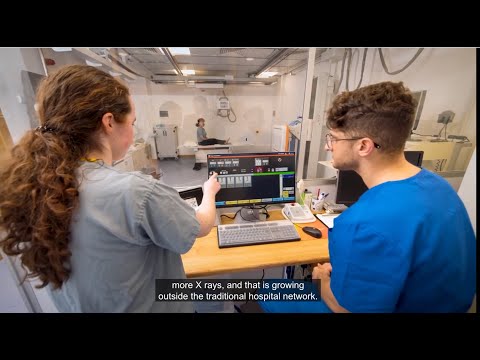
UCD Radiography
UCD - Future Students
Required Education
The standard route into radiography in Ireland is a four-year BSc in Radiography at NFQ Level 8, offered at University College Dublin (UCD) and other approved higher education institutions; entry is through the CAO and is competitive, requiring strong Leaving Certificate results. Useful Leaving Certificate subjects include Biology, Physics, Chemistry, and Mathematics at Higher level, as these underpin the scientific content of the degree. The programme combines academic study with substantial supervised clinical placements in HSE and approved hospitals, giving you hands-on experience before you graduate. On graduation, you must register with CORU (the Health and Social Care Professionals Council) as a Radiographer before you can practise legally in Ireland. Continuing professional development (CPD) is required to maintain your CORU registration throughout your career. There is currently no widely established apprenticeship or PLC route into qualified Radiographer status in Ireland, making the Level 8 degree the primary pathway.
Required Skills
Career Perspective
Most newly qualified Radiographers begin their careers as Staff Radiographers in HSE acute hospitals or voluntary hospitals, often rotating across different imaging modalities. With experience, you may progress to Senior Radiographer, taking on greater clinical responsibility, supervising students, and often specialising in an area such as MRI, CT, interventional radiology, or mammography. Further progression can lead to Clinical Specialist or Advanced Practitioner roles, where you may report certain images independently or lead service developments. Management pathways exist through roles such as Superintendent Radiographer or Radiology Services Manager, and academic or research careers are also possible for those who pursue postgraduate study at NFQ Level 9 or 10.
AI Impact on the job
Artificial intelligence is beginning to assist radiologists and Radiographers through AI-powered image analysis tools that can flag potential abnormalities — such as fractures, nodules, or lesions — in X-ray and CT images, helping to prioritise urgent cases and reduce reporting backlogs. These tools are designed to support rather than replace clinical judgement, and a qualified Radiographer's expertise in patient positioning, image acquisition, and quality assurance remains essential and cannot be automated. AI-driven workflow optimisation within PACS and RIS systems is also streamlining administrative tasks, allowing Radiographers to focus more time on direct patient care. Overall, AI is likely to enhance the Radiographer's role rather than diminish it, though ongoing engagement with new technology and continuing professional development will be increasingly important.
Career Ladder
→ Radiographer (Current role)
Related Studies
Employers in Ireland
Organisations in Ireland that employ people in this occupation.
Nationwide
Radiographers staff X-ray, CT, MRI and ultrasound departments nationwide.
Dublin 8
Major tertiary hospital with high-volume diagnostic imaging across all modalities.
Beaumont, Dublin 9
Busy radiology department covering emergency, neuroscience and cancer imaging.
Dublin 7
Radiographers perform diagnostic and interventional imaging in a leading teaching hospital.
Wilton, Cork
Regional tertiary centre with large radiology department and specialist imaging services.
Dublin, Cork, Galway, Limerick
Private hospital group employing radiographers across diagnostic and interventional imaging.
Cork, Dublin, Galway, Tralee, Limerick
Radiographers deliver X-ray, CT, MRI and ultrasound imaging across private hospitals.
Dublin, Cork, Galway, Nationwide
Specialist diagnostic imaging provider operating MRI, CT and ultrasound clinics nationwide.
Dublin, Nationwide
Healthcare staffing agency placing radiographers in temporary and permanent hospital roles.
Crumlin and Temple Street, Dublin
Paediatric radiographers perform specialist imaging for children across CHI hospital sites.
Newcastle Road, Galway
Radiographers support a busy west-of-Ireland tertiary centre across all imaging modalities.
We don't know whether these employers currently have vacancies — always check their own website. And if there's somewhere you'd really love to work, it can be worth applying anyway, even without an open vacancy.
Our tools can help you with that:

This website uses cookies
We use functional cookies and — with your consent — cookies for preferences, statistics and marketing.