Install Findmino as an app for the best experience!
Toolmaking Apprenticeship
Tech & Engineering
Duration
4 years
Level
Apprenticeship
Outlook
Growing
What will you learn?
A Toolmaking apprenticeship trains you to design, manufacture and maintain the precision tools, moulds, dies and jigs used in industries such as med-tech, plastics and general manufacturing. You develop skills in manual machining, CNC programming and operation, grinding, fitting and assembly, as well as metrology — the science of precision measurement. Your week alternates between on-the-job training with your employer and scheduled off-the-job phases at an Education and Training Board (ETB) training centre or Institute of Technology. You work with tight tolerances measured in micrometres, learning to read engineering drawings and use CAD/CAM software. Ireland's strong med-tech sector — home to companies such as Boston Scientific, Cook Medical and Abbott — means demand for toolmakers with medical-grade precision skills is particularly high.
Videos about Toolmaking Apprenticeship
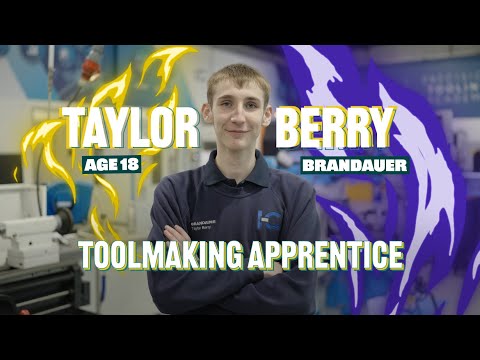
Taylor: Toolmaking Apprentice
Required Education
Entry is through an employer who registers you as an apprentice with SOLAS via apprenticeship.ie; you must be at least 16 years of age and have left full-time second-level education. Most employers expect a Leaving Certificate (or equivalent), with passes in Maths, Engineering or Technical Graphics being a strong advantage; Higher-level Maths is not always required but demonstrates the numerical aptitude needed for precision work. A Junior Cycle or Leaving Certificate with grades in technical subjects (e.g. Engineering, Materials Technology, Applied Mathematics) will strengthen your application considerably. Some employers accept QQI Level 5 or 6 FET awards in Engineering or Manufacturing as an alternative entry pathway. There is no CAO application involved — you apply directly to an approved employer, who then registers the apprenticeship with SOLAS. Mature applicants (21+) and those with relevant trade or manufacturing experience are considered on a case-by-case basis by individual employers.
Core Subjects
Career Prospects
Ireland's med-tech industry is one of the largest in Europe, and demand for skilled toolmakers consistently outstrips supply, making employment prospects very strong for qualified apprentices. Graduates typically move into permanent roles with their apprenticeship employer or can readily find work across the sector. Salaries for newly qualified toolmakers generally range from approximately €35,000 to €45,000 gross per year, rising to €55,000 or more for experienced or lead toolmakers. The reshoring of precision manufacturing and continued growth in medical devices and pharmaceutical packaging further support long-term job security in this trade.
Impact of AI on this program
AI and machine learning are beginning to influence toolmaking through intelligent CNC machining centres that self-optimise cutting parameters and predictive-maintenance systems that reduce downtime on tooling equipment. CAD/CAM software increasingly incorporates AI-assisted design features that suggest optimal mould geometry or tool paths, speeding up the design phase. However, the hands-on diagnostic skill, manual dexterity and fine judgement required to set, adjust and repair precision tooling means that human expertise remains essential and cannot easily be automated. Toolmakers who develop competence in digital manufacturing technologies alongside traditional craft skills will be best positioned as the sector evolves.
Where can you study this?Providers and indicative points are curated with AI support. Always double-check with the institution itself.
Verified yesterday
Providers and indicative points are curated with AI support. Always double-check with the institution itself.
How to apply
The Toolmaking Apprenticeship is an employer-led programme registered with SOLAS; applicants must first secure a position with an approved employer who then registers them as an apprentice through the Generation Apprenticeship / SOLAS portal. Off-the-job training and assessment phases are delivered at designated ETB training centres, with no CAO application involved.
Similar Studies
Accounting Technician Apprenticeship
The Accounting Technician Apprenticeship is a two-year 'earn and learn' programme where you split your time between a real workplace and structured...
2 years
ApprenticeshipAdvanced Healthcare Assistant Practitioner Apprenticeship
This two-year earn-and-learn apprenticeship trains you to become an Advanced Healthcare Assistant Practitioner while you continue working in a...
4 years
ApprenticeshipAgricultural Mechanics Apprenticeship
This apprenticeship trains you to inspect, diagnose, maintain and repair agricultural machinery — from tractors and combine harvesters to...
4 years
ApprenticeshipAircraft Maintenance Apprenticeship
This apprenticeship trains you to inspect, service, and repair commercial and general aviation aircraft to the highest safety standards. You will...
4 years
ApprenticeshipAirNav Ireland Student Controller Programme
The AirNav Ireland Student Controller Programme trains you to become a licensed Air Traffic Controller (ATC) responsible for the safe and efficient...
2 years
Discover more on Findmino
Other studies, careers, ideas and blogs you might not know yet.
This website uses cookies
We use functional cookies and — with your consent — cookies for preferences, statistics and marketing.