Install Findmino as an app for the best experience!
Carpenter
(Joiner, Woodworker, Site Carpenter, Carpentry Framer)
Construction & Trades
Salary
€30,000 - €62,000/yr
Level
Operational
Outlook
Growing
Sector
Construction & Trades
What does a Carpenter do?
As a Carpenter you cut, shape, and assemble timber and other materials to construct and finish buildings, furniture, and structures. Your daily work involves reading technical drawings, measuring and cutting materials to precise dimensions, and fitting elements such as door frames, staircases, roof trusses, and floor systems. You work closely with other tradespeople including electricians, plumbers, and plasterers on construction sites, in workshops, or in domestic settings. Depending on your specialisation, you may focus on first-fix structural work such as timber framing, or second-fix joinery such as skirting boards, architraves, and fitted furniture. Attention to detail and a practical, problem-solving mindset are central to the role.
A Day in the Life
Listen: a day as a Carpenter
Your alarm goes off at 6.15 a.m. You grab a flask of coffee and drive to the housing development on the edge of town where your employer, a local building contractor, is working on a terrace of twelve new homes. You are expected on site by 7.30 a.m., so you allow time to sign in at the site office, pull on your hard hat and high-vis vest, and check the day's schedule with the site foreman. This morning you are on first-fix work, which means the structural timber work that happens before the walls are plastered. You spend the first two hours cutting and fitting floor joists on the first floor of one of the mid-terrace houses. You read off the architectural drawings, mark each joist with a pencil and set square, then cut them to length with a circular saw before nailing them into position. Every measurement has to be exact — a five-millimetre error here causes problems for every trade that follows you.
Videos about Carpenter
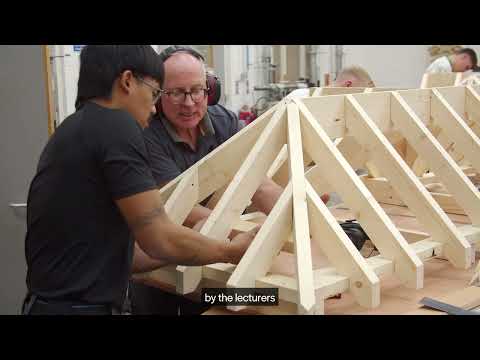
Carpentry and Joinery Apprenticeship at ATU
Atlantic Technological University
Required Education
The main route into carpentry in Ireland is through the Carpentry and Joinery apprenticeship, registered with SOLAS and delivered on an earn-and-learn basis, leading to an NFQ Level 6 Advanced Certificate Craft. Leaving Certificate subjects such as Construction Studies, Engineering, Technical Graphics, and Mathematics are particularly useful and can strengthen your apprenticeship application. Apprentices spend alternating periods working with a registered employer and attending off-the-job training at an Education and Training Board (ETB) or Institute of Technology campus. A QQI Level 5 Construction Studies PLC course is another entry point that can help you secure an apprenticeship employer. No specific CAO points route is required, as entry is employer-led rather than college-led. There is no statutory professional registration body for carpenters in Ireland, though membership of Construction Industry Federation (CIF) trade networks can support career development.
Required Skills
Career Perspective
Most carpenters begin as apprentices, working under a qualified tradesperson while completing their NFQ Level 6 qualification over approximately four years. After qualifying, you typically work as a fully skilled carpenter on residential, commercial, or fit-out projects, building experience across different sectors. With several years of experience, you may progress to a site foreman or contracts supervisor role, overseeing other tradespeople and managing schedules and materials. Some experienced carpenters move into self-employment, set up their own joinery business, or move into estimating, project management, or site management roles, sometimes supported by further qualifications in construction management.
AI Impact on the job
AI and digital technology are beginning to influence carpentry through tools such as computer-aided design (CAD) software and CNC (computer numerical control) cutting machinery, which automate some repetitive cutting and shaping tasks in workshop environments. However, the physical, adaptive, and site-based nature of most carpentry work means that full automation remains a distant prospect. AI can assist with project planning, material estimation, and waste reduction, improving efficiency rather than replacing the tradesperson. Carpenters who develop familiarity with digital tools and prefabrication methods will be well placed as the industry modernises.
Career Ladder
→ Carpenter (Current role)
Related Studies
Carpentry and Joinery Apprenticeship
4 year • Tech & Engineering
FETConstruction Skills (QQI Level 5)
1 year • Tech & Engineering
FETUpholstery and Furniture Restoration (QQI Level 5)
1 year • Trades & Services
ApprenticeshipWood Manufacturing and Finishing Apprenticeship
4 year • Trades & Services
BachelorFurniture Design and Manufacture
4 year • Creative Arts & Design
BachelorSustainable Timber Technology and Building
4 year • Tech & Engineering
Employers in Ireland
Organisations in Ireland that employ people in this occupation.
Nationwide
Carpenters work on major commercial and residential construction projects.
Dublin, Nationwide
Carpenters carry out structural and finishing work on large-scale builds.
Dublin, Nationwide
Carpenters complete fit-out and structural carpentry on national projects.
Nationwide
Carpenters maintain and restore state buildings and heritage properties.
Dublin
Carpenters repair and maintain social housing and council buildings.
Dublin, Nationwide
Carpenters support fit-out and construction on data centres and pharma sites.
Nationwide
Carpenters provide specialist trade services and in-store fitting expertise.
Co. Dublin
Specialist carpenters craft bespoke joinery and fitted furniture solutions.
Nationwide
Carpenters maintain and repair facilities across prison estates nationwide.
Co. Tipperary, Nationwide
Carpenters deliver structural and finishing work across construction contracts.
Dublin, Nationwide
Carpenters install drylining and partition systems in commercial builds.
We don't know whether these employers currently have vacancies — always check their own website. And if there's somewhere you'd really love to work, it can be worth applying anyway, even without an open vacancy.
Our tools can help you with that:
Read more about this work

This website uses cookies
We use functional cookies and — with your consent — cookies for preferences, statistics and marketing.